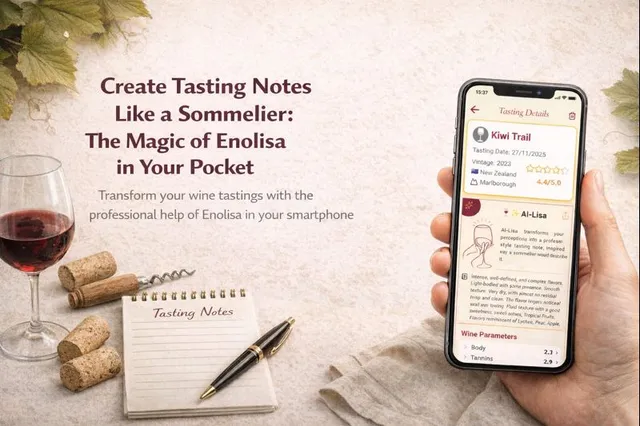
Tasting notes inspired by how a sommelier would do it
Describing a wine is not always easy. We often know we like it —or not— but struggle to put into words what we truly sense in the glass. “It’s smooth”, “it’s fruity”, “it goes down well” are common phrases, yet limited. Learning to taste is not about memorizing jargon or becoming an expert; it is about organizing sensations and giving them coherent language.
This is the context for one of Enolisa’s key features: structured tasting notes that help you transform perceptions into a clear, consistent, and useful description, inspired by a professional sommelier’s approach.
This article explains how the process works, what it gives a wine lover, and why recording a tasting correctly improves both experience and personal knowledge.
What a tasting note is and why it matters
A tasting note is the result of observing, analyzing, and describing a wine through what we perceive with our senses: sight, nose, and palate. It is not about judging whether a wine is “good” or “bad”, but about understanding its style, structure, and balance.
Keeping tasting notes brings several clear benefits:
- Helps you remember wines more precisely
- Lets you spot patterns in your tastes and preferences
- Makes it easier to compare wines objectively
- Gradually improves your vocabulary and personal criteria
The usual obstacle is not knowing where to start or how to structure the information. That is where Enolisa adds value.
From sensation to language: Enolisa’s approach
Enolisa does not ask you to write a complex description from scratch. Instead, it offers a guided tasting model based on clear, understandable parameters that reflect how a wine is analyzed in a technical tasting.
While logging a tasting, you select your perceptions for aspects such as:
- Body: weight and volume on the palate
- Tannins: dryness and structure
- Sweetness: perception from dry to sweet
- Intensity: aromatic and flavor power
- Finish: length of sensations after swallowing
You can also add recognized aromas and flavors from an organized library that includes common references like fruit, flowers, spices, toasted notes, or wood nuances.
This approach removes the initial uncertainty and lets you focus on what matters: what you truly perceive when tasting.
Coherent interpretation of the tasting
Once these elements are recorded, Enolisa turns that input into a written tasting note in natural, fluent language. It does not simply list attributes; it weaves them into a complete description of the wine.
The goal is not to embellish or add external information, but to express exactly what you indicated, in an orderly and understandable way.
For example, the combination of body, sweetness, and tannins shapes the texture; intensity and finish define the wine’s character; the aromas you select add context and depth.
The result reads like a structured analysis —similar to a professional tasting sheet— but built solely from your own perceptions.
Learning to taste better with every bottle
One of the biggest advantages is that it trains your palate over time. By repeating the process with different wines, you:
- Learn to identify nuances with greater precision
- Gain confidence when describing what you sense
- Better understand why one wine appeals to you and another does not
- Develop a more consistent personal benchmark
Tasting stops being just intuitive and becomes conscious and comparable, without losing spontaneity.
Your digital tasting diary
Each note you create in Enolisa is linked to its wine inside your personal diary. Over time, this becomes a detailed record of experiences, useful to remember bottles and to analyze how your tastes evolve.
This organized log lets you revisit wines you have tasted, compare styles, review past impressions, and build a deeper relationship with wine based on real experience.
Accessible tastings without complications
You do not need prior training or advanced technical knowledge. The system is designed for fans, enthusiasts, and wine lovers who want to enjoy each glass more and understand what they drink.
The technology stays in the background. The focus is on the experience: taste, record, learn, and remember.
Conclusion
Creating tasting notes is not just about words; it is about sensory understanding and memory. Enolisa makes this easy with a clear structure and careful writing, based solely on what you perceive.
Each wine becomes more than a bottle: a documented, understandable, personal experience.
If you want to deepen your wine journey without complications and build your own digital tasting diary, Enolisa is designed to accompany you, glass by glass.