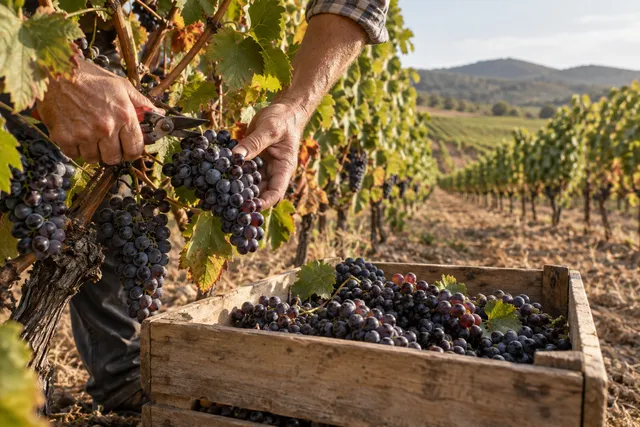
The 2026 wine harvest in Spain is under way, but it does not follow one national timetable. Spain’s range of climates, elevations, grape varieties and wine styles means picking can begin in August in some areas and continue into October in others.
This is a dated, living guide to the Spanish campaign. Its purpose is to track what is known without turning early ripening data into a premature verdict on the 2026 Spanish wine vintage.
Updated September 12, 2026. The campaign is active and official observations are available for specific regions, but it is too early to rate the Spanish vintage as a whole.
When does the wine harvest begin in Spain?
The calendar alone does not decide the picking date. Growers and wineries monitor sugar, acidity, aromas, grape health and phenolic ripeness. The intended wine style also matters: grapes for a fresh sparkling wine may be picked before a late-ripening red variety from the same broad area.
This timeline is a general orientation:
| Typical period | Frequent areas and situations | Factors that move the date |
|---|---|---|
| August | Canary Islands, warmer southern and Mediterranean sites, grapes for some sparkling wines | Heat, low elevation, early varieties or the need to retain acidity |
| Late August and September | Large parts of central and eastern Spain, Catalonia and the Ebro valley | Vineyard conditions, rain, grape destination and wine style |
| September and October | Rioja, Ribera del Duero, Galicia and higher or Atlantic-influenced vineyards | Cooler nights, elevation, exposure and long-cycle varieties |
These are not fixed boundaries. Two plots in the same appellation can be picked weeks apart because of elevation, orientation, soil or grape variety.
How is the 2026 harvest progressing?
Every update needs both a place and a date. In its September 10 ripening bulletin, the Rioja regulatory council described harvesting as generalized across the region. High temperatures had accelerated sugar accumulation, while total acidity and malic acid were falling. Phenolic-ripeness indicators were developing favorably and overall vineyard health remained excellent.
The bulletin also called for continued monitoring of plots affected by water or heat stress and those still awaiting harvest. Cooler nights in the forecast were considered favorable for the final stages of phenolic ripening.
This is valuable evidence for Rioja, not a shortcut to describing the whole of Spain. An Atlantic vineyard, a Mediterranean site, a high inland plateau and an island vineyard can be at very different stages.
The economic setting behind the crop
Harvest is shaped by more than vineyard conditions. Appellations define yields and controls to protect origin and manage production. Rioja’s 2026 harvest rules maintain limits on protected yields and regulate how excess production must be handled.
Spain’s Ministry of Agriculture also activated a green-harvest program with a €15.9 million budget. On participating land, grapes are removed before ripening to help balance supply and demand. It is an economic-management measure, not a quality assessment of the grapes that are harvested.
The Ministry’s wine-sector portal provides broader sector information and INFOVI market data.
What does “2026 vintage” actually mean?
A vintage names the year in which the grapes were harvested, but the meaning of that year reaches across the entire cycle:
- Temperature and rainfall during the growing season.
- Budbreak, flowering and ripening.
- Grape health and balance at picking.
- Harvest timing and fruit selection.
- Fermentation, ageing and the wine’s later development.
There is therefore no single, uniform “Spain 2026 vintage.” Results can differ between regions, villages, varieties, producers and even neighboring plots.
Why it is too early to rate the 2026 vintage
Healthy fruit and favorable phenolic development are encouraging signals, but they cannot predict every finished wine. Fermentation still has to take place, and many styles will then spend months or years ageing.
It helps to separate three stages:
- Vineyard data: grape health, sugar, acidity and phenolic ripeness.
- Winemaking outcome: fermentation, extraction and initial balance.
- Vintage assessment: the quality, character and development of finished wines.
Early reports from growers, wineries and regulatory councils add context. A dependable assessment comes later, once wines can be tasted and followed over time.
How to follow 2026 Spanish wines with Enolisa
Harvest season is a useful moment to save the names that will later appear on 2026-vintage labels.
- Use Enolisa’s global wine search to look up wines, producers and regions.
- Save interesting references to To discover while you wait for their release.
- When you have a bottle, scan its label to identify it and register the vintage.
- Add a personal tasting note to preserve how the wine develops and compare it with other years.
This turns “2026 vintage” from a broad headline into a record of specific wines: their producer and origin, when you tasted them and what you found in the glass.
Future updates
We will update this guide as official harvest summaries become available and the first reliable regional assessments emerge. Each revision will remain dated so current evidence stays separate from conclusions that still need time.